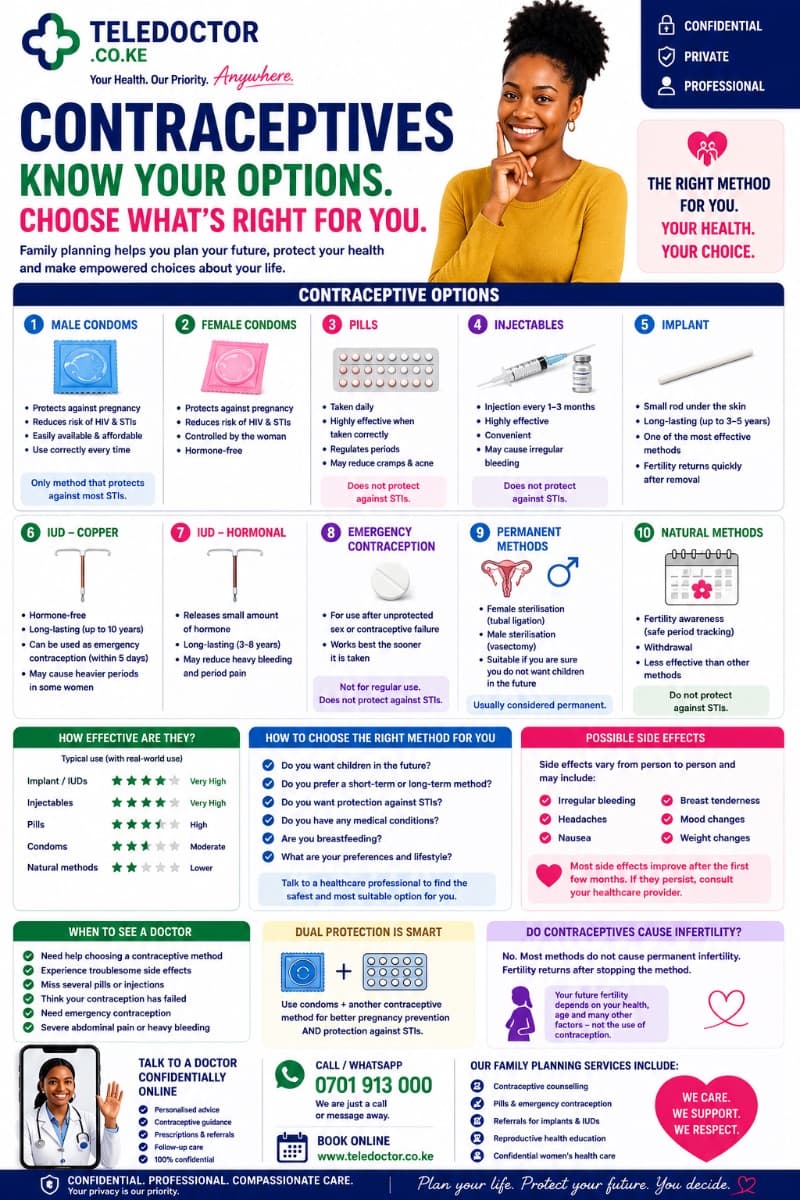
Choosing a contraceptive is a personal healthcare decision. The right method depends on your health, lifestyle, reproductive goals, and personal preferences. Modern contraceptives are safe, effective, and available in many forms, allowing individuals and couples to plan pregnancies and protect their reproductive health.
Whether you want to delay your first pregnancy, space your children, or avoid pregnancy altogether, understanding your options can help you make an informed choice.
⸻
What Is Contraception?
Contraception refers to methods used to prevent pregnancy. Some methods also reduce the risk of sexually transmitted infections (STIs), while others are designed solely to prevent pregnancy.
No single method is perfect for everyone. Discussing your medical history and future plans with a healthcare professional can help you choose the most appropriate option.
⸻
Types of Contraceptives
- Male Condoms
Male condoms are thin sheaths worn over the penis during sex.
Benefits
- Protect against pregnancy
- Reduce the risk of HIV and many other STIs
- Easily available
- Affordable
- No hormones
Possible Disadvantages
- Must be used correctly every time
- Can tear or slip if used incorrectly
Condoms remain the only widely available contraceptive method that also protects against most sexually transmitted infections.
⸻
- Female Condoms
Female condoms are placed inside the vagina before sexual intercourse.
Benefits
- Protect against pregnancy
- Reduce STI risk
- Controlled by the receiving partner
- Hormone-free
⸻
- Combined Oral Contraceptive Pills
These pills contain oestrogen and progestogen and are taken daily.
Benefits
- Highly effective when taken correctly
- May reduce painful periods
- Can help regulate menstrual cycles
- May improve acne in some people
Possible Side Effects
- Nausea
- Breast tenderness
- Mild headaches
- Spotting between periods
Some women should not use combined pills, particularly those with certain medical conditions or risk factors. A healthcare professional can advise whether they are suitable.
⸻
- Progestogen-Only Pills (Mini-Pill)
These contain only progestogen and may be suitable for women who cannot use oestrogen.
⸻
- Contraceptive Injection
An injection given every few months (depending on the formulation) that releases progestogen.
Benefits
- Highly effective
- Convenient
- No daily tablets
Possible Side Effects
- Irregular bleeding
- Weight changes in some users
- Delayed return to fertility after stopping for some women
⸻
- Contraceptive Implant
A small flexible rod inserted under the skin of the upper arm by a trained healthcare provider.
Benefits
- One of the most effective contraceptive methods
- Long-lasting (typically several years, depending on the implant)
- Reversible
Possible Side Effects
- Irregular bleeding
- Headaches
- Breast tenderness
Fertility generally returns quickly after removal.
⸻
- Intrauterine Device (IUD)
An IUD is placed inside the uterus by a trained healthcare provider.
Copper IUD
- Hormone-free
- Long-lasting
- Can also be used as emergency contraception if inserted within the recommended timeframe after unprotected sex
Hormonal IUD
- Releases a small amount of progestogen
- May reduce heavy menstrual bleeding and period pain
- Long-lasting and reversible
Some women experience cramping or irregular bleeding during the first few months after insertion.
⸻
- Emergency Contraception
Emergency contraception helps reduce the chance of pregnancy after unprotected sex or contraceptive failure.
Options include:
- Emergency contraceptive pills
- Copper IUD (when appropriate)
Emergency contraception should be used as soon as possible after unprotected sex and does not protect against STIs.
⸻
- Permanent Contraception
Permanent methods are suitable for individuals or couples who are certain they do not wish to have children in the future.
Examples include:
- Female sterilisation (tubal ligation)
- Male sterilisation (vasectomy)
These procedures should be considered irreversible in most cases.
⸻
How Effective Are Different Methods?
When used correctly:
- Implants and IUDs: Among the most effective methods because they do not rely on daily use.
- Injectables: Highly effective when injections are received on schedule.
- Oral contraceptive pills: Very effective when taken consistently at the same time each day.
- Condoms: Effective when used correctly and consistently, with the added benefit of reducing STI risk.
No contraceptive method is 100% effective except abstinence.
⸻
How Do I Choose the Right Contraceptive?
Your healthcare provider will consider:
- Your age
- Whether you want children in the future
- Your medical history
- Current medications
- Smoking status
- Breastfeeding status
- Menstrual symptoms
- Risk of sexually transmitted infections
- Personal preferences
The best contraceptive is one that is safe for you, fits your lifestyle, and that you are comfortable using correctly.
⸻
Do Contraceptives Cause Infertility?
No.
Most contraceptive methods do not cause permanent infertility.
For most methods, fertility returns soon after stopping. With injectable contraception, there may be a delay before fertility returns, but this does not mean permanent infertility.
⸻
Can I Use More Than One Method?
Yes.
Many people choose dual protection, such as using condoms together with another contraceptive method.
This provides:
- Better pregnancy prevention
- Protection against HIV and many other STIs
⸻
Possible Side Effects
Side effects vary depending on the method.
Some people experience:
- Irregular bleeding
- Mild headaches
- Breast tenderness
- Mood changes
- Nausea
Many side effects improve after the first few months.
If symptoms are severe or persistent, consult your healthcare provider.
⸻
When Should You See a Doctor?
Seek medical advice if you:
- Need help choosing contraception
- Experience troublesome side effects
- Miss several contraceptive pills
- Think your contraception has failed
- Need emergency contraception
- Develop severe abdominal pain, heavy bleeding, or other concerning symptoms
⸻
Can Family Planning Be Discussed During an Online Consultation?
Yes.
An online consultation is a convenient way to discuss contraception.
A licensed healthcare professional can:
- Explain available contraceptive options
- Help you choose the most appropriate method
- Discuss benefits and possible side effects
- Advise on emergency contraception
- Arrange prescriptions where appropriate
- Refer you for procedures such as implant or IUD insertion when needed
⸻
Family Planning Empowers You to Make Informed Choices
Contraception allows individuals and couples to plan pregnancies, protect their health, and make decisions that align with their goals and circumstances.
Choosing the right method is easier when you have accurate information and professional guidance.
⸻
Book a Confidential Family Planning Consultation with Teledoctor Kenya
If you have questions about contraception or would like help choosing the best method for you, Teledoctor Kenya is here to help.
Our licensed healthcare professionals provide confidential online consultations, personalised advice, prescriptions where appropriate, and referrals for contraceptive procedures.
Call or WhatsApp: 0701 913 000
Book your confidential family planning consultation today and make informed decisions about your reproductive health.
⸻
Frequently Asked Questions
Which contraceptive is the most effective?
Long-acting reversible contraceptives such as implants and IUDs are among the most effective methods because they do not depend on daily use.
Do contraceptive pills protect against HIV or STIs?
No. Oral contraceptive pills prevent pregnancy but do not protect against HIV or other sexually transmitted infections. Condoms help reduce the risk of both.
Can I get pregnant immediately after stopping contraception?
For most methods, fertility returns quickly after stopping. After injectable contraception, fertility may take longer to return for some women.
Is emergency contraception an abortion pill?
No. Emergency contraception works to reduce the chance of pregnancy before it is established. It does not terminate an existing pregnancy.
Can I choose contraception during an online consultation?
Yes. Teledoctor Kenya can provide confidential family planning advice, discuss suitable contraceptive methods, prescribe eligible medications where appropriate, and refer you for procedures such as implant or IUD insertion.