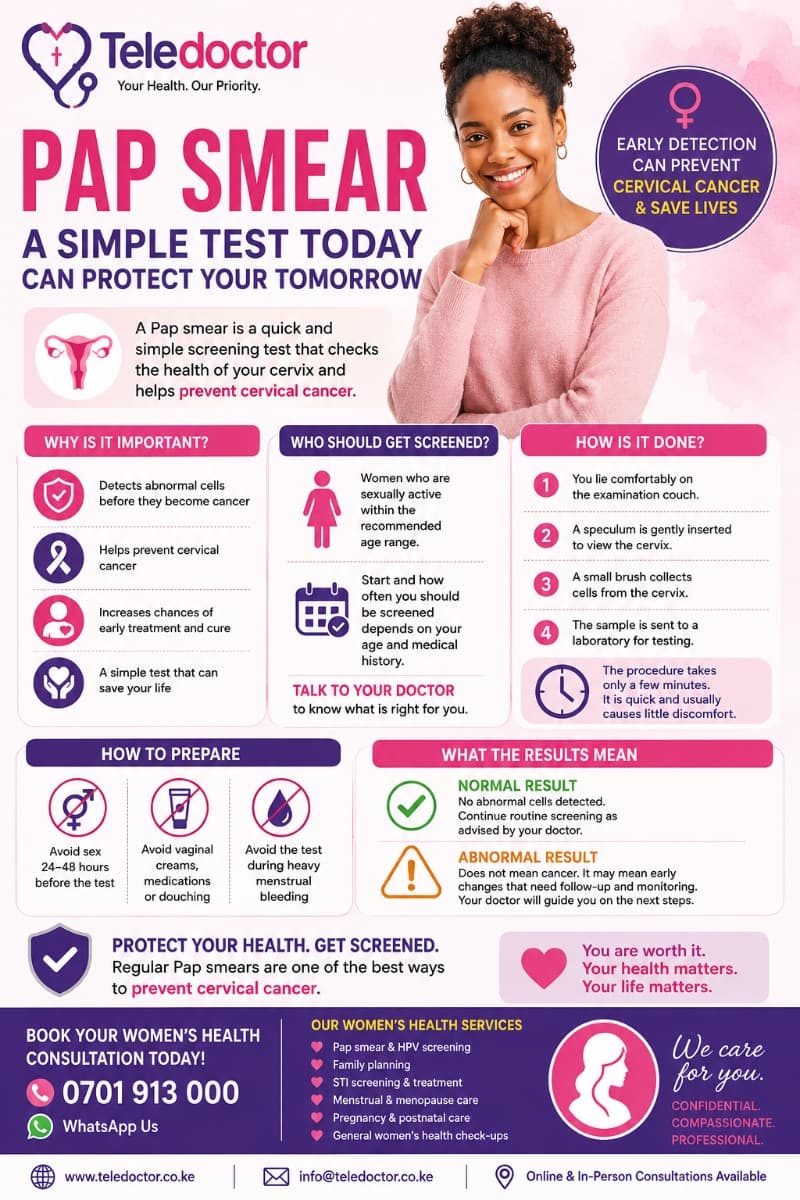
Pap Smear: A Simple Test That Can Save Your Life
Cervical cancer is one of the leading cancers affecting women in Kenya. The good news is that it is also one of the most preventable cancers when detected early through regular screening.
A Pap smear (also called a Pap test) is a simple, quick, and effective screening test that detects abnormal changes in the cells of the cervix before they develop into cervical cancer.
At Teledoctor Kenya, we encourage every eligible woman to undergo routine cervical cancer screening as part of her regular healthcare.
What Is a Pap Smear?
A Pap smear is a screening test in which a healthcare professional gently collects a small sample of cells from the cervix, the lower part of the uterus that opens into the vagina.
The sample is examined in a laboratory to detect:
- Abnormal cervical cells
- Precancerous changes
- Early cervical cancer
- Certain infections or inflammation
The goal is to identify changes early before cancer develops.
What Is the Cervix?
The cervix is the lower, narrow part of the uterus that connects the womb to the vagina.
It plays an important role in:
- Menstruation
- Pregnancy
- Childbirth
Most cervical cancers begin with slow changes in the cells of the cervix, making regular screening highly effective.
Why Is a Pap Smear Important?
A Pap smear can:
- Detect precancerous changes before they become cancer
- Identify cervical cancer at an early, more treatable stage
- Reduce the risk of developing cervical cancer
- Help guide early treatment when abnormalities are found
Routine screening has significantly reduced cervical cancer deaths worldwide.
What Causes Cervical Cancer?
The majority of cervical cancers are caused by persistent infection with high-risk types of Human Papillomavirus (HPV).
HPV is a very common virus transmitted through sexual contact.
Most HPV infections clear naturally, but some persist and can gradually cause abnormal cervical cell changes.
Who Should Have a Pap Smear?
Screening recommendations may vary depending on national guidelines and individual risk factors.
In general, women should discuss cervical cancer screening with their healthcare provider if they:
- Are within the recommended screening age range
- Have ever been sexually active
- Have a cervix
- Have previously had abnormal Pap smear results
- Have risk factors such as HIV infection or a weakened immune system
Women who have had a total hysterectomy for non-cancerous reasons may not require ongoing Pap smears, depending on their medical history.
How Often Should You Be Screened?
The ideal screening interval depends on:
- Your age
- Previous Pap smear results
- Whether HPV testing is also performed
- Your medical history
- National cervical screening recommendations
Your healthcare provider will recommend the most appropriate schedule for you.
Preparing for a Pap Smear
To improve the accuracy of the test:
Try to avoid for 24–48 hours before the test:
- Sexual intercourse
- Vaginal creams or medications (unless prescribed)
- Douching
- Vaginal lubricants
It is also preferable to avoid scheduling the test during heavy menstrual bleeding.
What Happens During the Procedure?
A Pap smear usually takes only a few minutes.
During the examination:
- You lie comfortably on an examination couch.
- A speculum is gently inserted into the vagina to allow the cervix to be seen.
- A small soft brush or spatula collects cells from the cervix.
- The sample is placed into a special container and sent to the laboratory.
The procedure is generally well tolerated.
Some women experience mild discomfort or pressure, but it should not be very painful.
After the Test
You can return to your normal daily activities immediately.
Some women notice:
- Mild spotting
- Slight cramping
These symptoms usually resolve within a day.
Seek medical advice if you develop:
- Heavy bleeding
- Severe pain
- Fever
- Foul-smelling vaginal discharge
Understanding Your Results
Normal Result
This means no abnormal cervical cells were detected.
Continue routine screening according to your healthcare provider’s recommendation.
Abnormal Result
An abnormal result does not necessarily mean you have cancer.
It simply means that changes have been found in the cervical cells.
Many abnormalities are mild and resolve naturally.
Depending on the findings, your healthcare provider may recommend:
- Repeat Pap smear
- HPV testing
- Colposcopy (a closer examination of the cervix)
- Cervical biopsy if necessary
What Is HPV Testing?
HPV testing looks specifically for high-risk HPV types that can lead to cervical cancer.
In many settings, HPV testing is performed:
- Together with a Pap smear
- After an abnormal Pap smear
- As a primary screening test, depending on local guidelines
Pap Smear vs HPV Test
Although related, they are different tests. Pap Smear- Looks for abnormal cervical cells
HPV test - Detects high-risk HPV infection
Papsmear - Identifies early cell changes
HPV test- Identifies the virus that may cause those changes
Pap smear- Helps detect precancerous lesions
HPV test- Helps determine future risk Both tests play an important role in cervical cancer prevention.
Can HPV Vaccination Replace Pap Smears?
No.
Even women who have received the HPV vaccine should continue cervical cancer screening according to medical recommendations.
The vaccine greatly reduces the risk of cervical cancer but does not protect against every cancer-causing HPV type.
Who May Need More Frequent Screening?
Some women require closer follow-up, including those with:
- HIV infection
- Previous abnormal cervical screening results
- Weakened immune systems
- Previous cervical treatment
Your healthcare provider will advise you on the appropriate schedule.
Preventing Cervical Cancer
You can reduce your risk by:
- Receiving the HPV vaccine
- Attending regular cervical screening
- Practicing safer sex
- Avoiding smoking
- Seeking prompt treatment for abnormal results
- Keeping follow-up appointments
When Should You See a Doctor?
Book an appointment if you experience:
- Bleeding after sexual intercourse
- Bleeding after menopause
- Persistent abnormal vaginal bleeding
- Unusual vaginal discharge
- Persistent pelvic pain
These symptoms do not necessarily indicate cervical cancer but should always be evaluated.
Can Teledoctor Help?
Yes.
Teledoctor Kenya offers comprehensive women’s health services.
Our healthcare professionals can:
- Advise whether you are due for cervical screening
- Explain Pap smear results
- Arrange referrals for Pap smears and HPV testing
- Assess abnormal bleeding
- Recommend appropriate follow-up
- Provide HPV vaccination counselling
- Refer to gynecologists when specialized care is needed
Early Detection Saves Lives
A Pap smear is one of the most effective tools for preventing cervical cancer.
The procedure is quick, safe, and can detect abnormal cells long before they become cancerous. Regular screening, together with HPV vaccination and timely follow-up, offers the best protection.
If you are due for cervical cancer screening, don’t delay. A few minutes today could protect your health for years to come.
Book a Women’s Health Consultation with Teledoctor Kenya
Our experienced healthcare professionals provide confidential and compassionate care for women’s health needs.
Our services include:
- Pap smear referrals
- HPV testing guidance
- Cervical cancer screening
- Family planning
- STI screening
- Menopause care
- Fertility assessment
- Routine women’s health check-ups
📞 Call or WhatsApp: 0701 913 000
🌐 Visit: www.teledoctor.co.ke
📍 Online and In-Person Consultations Available
Frequently Asked Questions
Is a Pap smear painful?
Most women experience only mild discomfort or pressure during the procedure. It is usually quick and well tolerated.
How long does a Pap smear take?
The test itself usually takes less than five minutes.
Can I have a Pap smear during my period?
Light bleeding may be acceptable in some situations, but heavy menstrual bleeding can interfere with the accuracy of the test. Your healthcare provider may recommend rescheduling.
If my Pap smear is abnormal, do I have cancer?
No. Most abnormal results are not cancer. Many represent mild changes that either resolve naturally or can be treated before cancer develops.
Do I still need screening if I received the HPV vaccine?
Yes. HPV vaccination reduces risk but does not eliminate the need for routine cervical cancer screening.