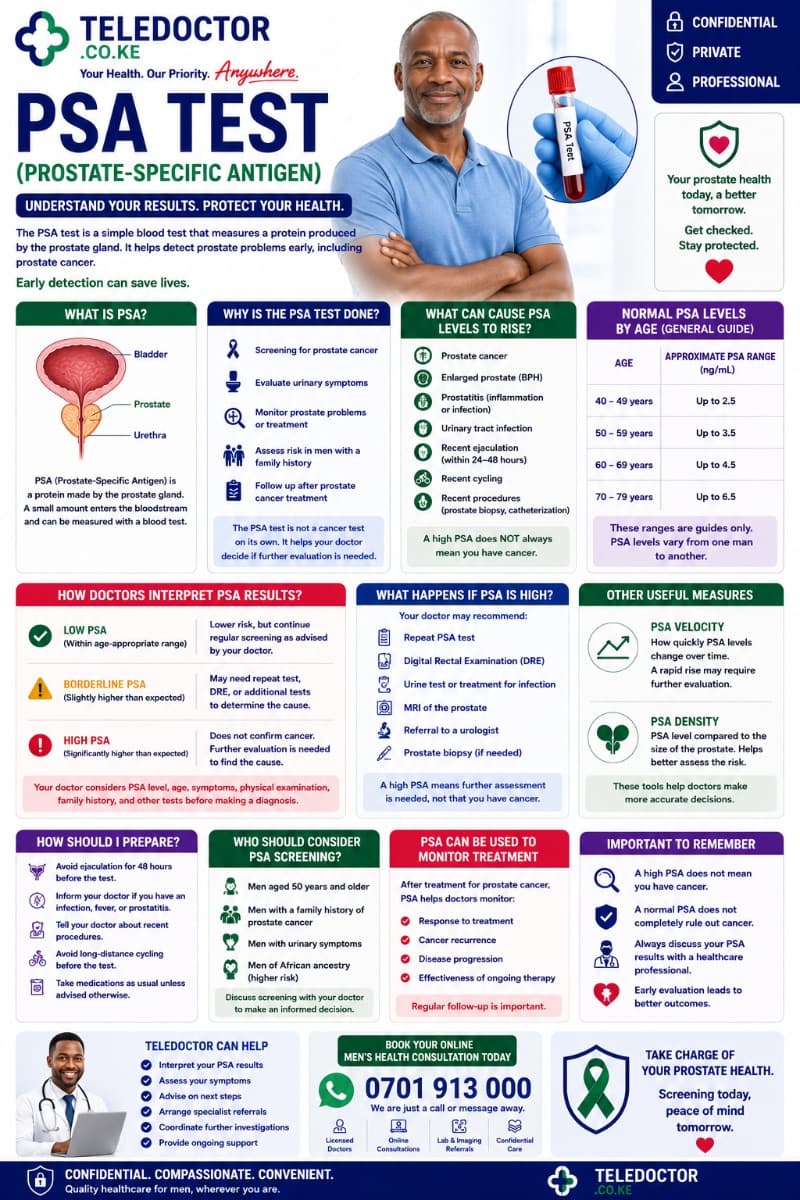
The Prostate-Specific Antigen (PSA) test is one of the most commonly used blood tests for assessing prostate health. It plays an important role in the early detection of prostate cancer, but it is not a cancer test on its own.
Many men become anxious after receiving a “high PSA” result. However, an elevated PSA does not necessarily mean you have prostate cancer. Several non-cancerous conditions can also increase PSA levels.
Understanding what the PSA test measures and how doctors interpret the results can help you make informed decisions about your health.
What Is PSA?
PSA (Prostate-Specific Antigen) is a protein produced almost exclusively by cells of the prostate gland.
A small amount normally enters the bloodstream and can be measured with a simple blood test.
Healthy men usually have low PSA levels, although PSA naturally tends to increase with age.
Why Is the PSA Test Performed?
Your doctor may recommend a PSA test if you:
- Have urinary symptoms
- Have difficulty passing urine
- Wake up frequently at night to urinate
- Notice blood in the urine or semen
- Have persistent pelvic discomfort
- Have a family history of prostate cancer
- Wish to discuss prostate cancer screening
- Are being monitored after prostate cancer treatment
The PSA test is also used to monitor men receiving treatment for prostate cancer.
What Can Cause PSA Levels to Rise?
An elevated PSA can occur due to several reasons.
- Prostate Cancer
Cancer cells may produce more PSA than normal prostate tissue.
However, not every man with prostate cancer has a markedly elevated PSA.
- Benign Prostatic Hyperplasia (BPH)
As men age, the prostate often enlarges.
This non-cancerous enlargement commonly increases PSA levels.
- Prostatitis
Inflammation or infection of the prostate may cause a temporary rise in PSA.
Symptoms may include:
- Fever
- Pelvic pain
- Painful urination
- Pain during ejaculation
- Urinary Tract Infection (UTI)
A urinary infection can temporarily elevate PSA.
Your doctor may recommend treating the infection before repeating the test.
- Recent Ejaculation
Ejaculation within 24–48 hours before the blood test may slightly increase PSA levels in some men.
Avoid ejaculation for 48 hours before testing if possible.
- Recent Cycling
Long-distance cycling may temporarily raise PSA in some men.
- Recent Medical Procedures
Procedures involving the prostate or urinary tract, such as catheterization or prostate biopsy, can temporarily increase PSA.
What Is a Normal PSA Level?
There is no single PSA value that guarantees a man does or does not have prostate cancer. Doctors interpret PSA results in the context of age, symptoms, physical examination, family history, and other investigations.
As a general guide, PSA levels tend to rise gradually with age because the prostate often enlarges over time.
Approximate age-related reference ranges that some clinicians use are:
40–49 years -Up to 2.5 ng/mL
50–59 years - Up to 3.5 ng/mL
60–69 years - Up to 4.5 ng/mL
70–79 years - Up to 6.5 ng/mL
These values are guides only and should not be used to diagnose or exclude prostate cancer.
Does a High PSA Mean I Have Prostate Cancer?
No.
Many men with elevated PSA levels do not have prostate cancer.
Likewise, some men with prostate cancer have PSA levels within the expected range.
A high PSA indicates that further assessment may be needed, not that cancer is definitely present.
What Happens If My PSA Is High?
Depending on your situation, your doctor may recommend:
- Repeating the PSA test after several weeks
- Treating any infection before retesting
- A Digital Rectal Examination (DRE)
- Multiparametric MRI of the prostate
- Referral to a urologist
- A prostate biopsy if clinically indicated
The decision depends on the PSA level, how quickly it is changing, your symptoms, examination findings, and individual risk factors.
PSA Velocity and PSA Density
Sometimes doctors use additional measures to improve assessment.
PSA Velocity
This refers to how quickly PSA levels change over time.
A rapidly rising PSA may warrant further evaluation, although PSA velocity alone should not be used to diagnose prostate cancer.
PSA Density
PSA density compares the PSA level with the size of the prostate (usually measured on imaging).
A large prostate naturally produces more PSA, so PSA density can help determine whether a PSA level is higher than expected for that prostate size.
Who Should Consider PSA Screening?
The decision to have a PSA test should be made after discussing the potential benefits and limitations with a healthcare provider.
Men who may particularly benefit from this discussion include:
- Men aged 50 years and older
- Men with a father or brother diagnosed with prostate cancer
- Men with persistent urinary symptoms
- Men of African ancestry, who may have a higher risk of prostate cancer
How Should I Prepare for a PSA Test?
To improve the accuracy of the test:
- Avoid ejaculation for 48 hours beforehand if possible.
- Inform your doctor if you have a urinary infection, fever, or prostatitis.
- Tell your healthcare provider about any recent prostate procedures.
- Continue taking prescribed medications unless advised otherwise.
Can PSA Be Used to Monitor Treatment?
Yes.
After treatment for prostate cancer, PSA is an important tool for monitoring:
- Response to treatment
- Cancer recurrence
- Disease progression
- Effectiveness of ongoing therapy
Regular follow-up helps guide long-term management.
Limitations of the PSA Test
While the PSA test is valuable, it has limitations.
It may:
- Be elevated for reasons other than cancer
- Miss some prostate cancers
- Detect slow-growing cancers that might never cause symptoms
- Lead to additional tests that may not always be necessary
For these reasons, PSA testing is best interpreted by an experienced healthcare professional.
Can Teledoctor Help?
Yes.
If you have questions about your PSA result or prostate health, Teledoctor Kenya can help.
Our licensed healthcare professionals can:
- Explain your PSA result
- Assess your symptoms
- Discuss whether repeat testing is appropriate
- Arrange referrals to urologists
- Review prostate cancer screening options
- Coordinate further investigations if needed
Don’t Panic About a High PSA
A raised PSA is not a diagnosis of prostate cancer. It is a signal that further assessment may be appropriate.
Many men with elevated PSA levels have benign conditions such as an enlarged prostate or prostatitis. Seeking professional advice early helps ensure you receive the right investigations and treatment if necessary.
Book an Online Men’s Health Consultation with Teledoctor Kenya
If you have urinary symptoms, a raised PSA level, or questions about prostate cancer screening, Teledoctor Kenya is here to help.
Our licensed healthcare professionals provide confidential online consultations, PSA result interpretation, referral for further investigations, and ongoing support for men’s health.
📞 Call or WhatsApp: 0701 913 000
🌐 Book your consultation at www.teledoctor.co.ke
Frequently Asked Questions
Should every man have a PSA test?
Not necessarily. PSA screening should be an informed decision made after discussing your individual risk factors, age, family history, and the potential benefits and drawbacks with a healthcare provider.
Can a normal PSA rule out prostate cancer?
No. Although a normal PSA reduces the likelihood of significant prostate cancer, it does not completely exclude it.
Can prostatitis raise PSA?
Yes. Prostatitis can significantly increase PSA levels. Your doctor may recommend treatment and repeating the PSA test after the inflammation has settled.
Can PSA decrease after treatment?
Yes. PSA often falls after successful treatment for prostate cancer or after treatment of benign conditions such as prostatitis.
When should I see a urologist?
You may be referred to a urologist if your PSA is persistently elevated, your Digital Rectal Examination is abnormal, or imaging suggests further evaluation is needed.