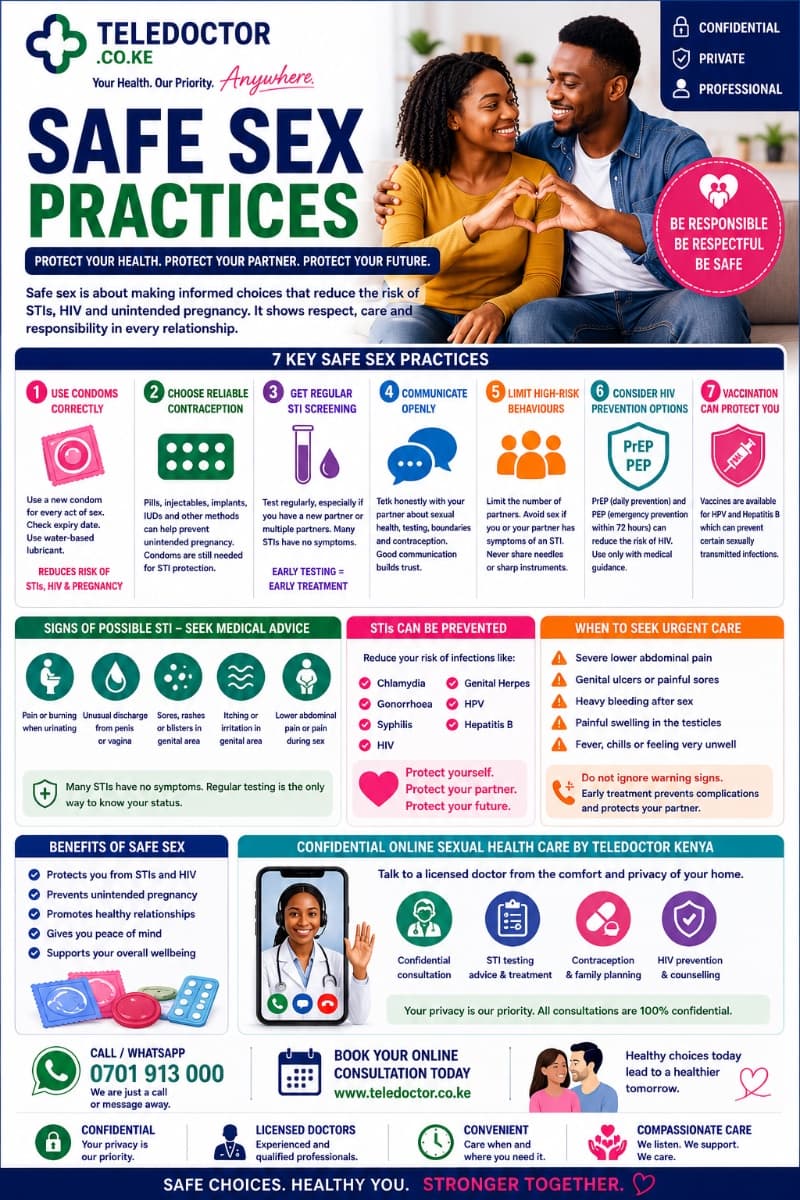
Healthy sexual relationships are built on trust, communication, mutual respect, and informed decision-making. Practising safer sex helps reduce the risk of sexually transmitted infections (STIs), unintended pregnancy, and other sexual health concerns.
Safe sex is not only about protecting yourself—it is also about protecting your partner and promoting long-term reproductive health.
⸻
What Is Safe Sex?
Safe sex refers to behaviours that reduce the risk of:
- Sexually transmitted infections (STIs)
- HIV transmission
- Unplanned pregnancy
- Reproductive health complications
No method completely eliminates risk except abstaining from sexual activity, but several strategies greatly reduce the likelihood of infection and unintended pregnancy.
⸻
Why Safe Sex Matters
Practising safer sex can help prevent infections such as:
- Chlamydia
- Gonorrhoea
- Syphilis
- HIV
- Genital herpes
- Human papillomavirus (HPV)
- Hepatitis B
Many STIs cause few or no symptoms, meaning people may unknowingly transmit an infection to others.
⸻
- Use Condoms Correctly and Consistently
Male and female condoms are among the most effective ways to reduce the risk of many STIs and HIV when used correctly and consistently.
To use condoms safely:
- Use a new condom for every act of vaginal or anal sex.
- Check the expiry date and packaging before use.
- Open the package carefully to avoid damaging the condom.
- Use water-based or silicone-based lubricants with latex condoms. Oil-based products can damage latex.
- Dispose of condoms safely after use.
Condoms also help reduce the risk of unintended pregnancy, although no contraceptive method is 100% effective.
⸻
- Consider Reliable Contraception
If you wish to prevent pregnancy, discuss contraceptive options with a healthcare professional.
Common methods include:
- Contraceptive pills
- Injectable contraception
- Implants
- Intrauterine devices (IUDs)
- Emergency contraception (when appropriate)
Most contraceptive methods do not protect against STIs, so condoms remain important for infection prevention.
⸻
- Get Regular STI Screening
Routine testing is recommended if you:
- Have a new sexual partner
- Have multiple sexual partners
- Have had unprotected sex
- Have symptoms of an STI
- Have a partner diagnosed with an STI
Early diagnosis allows prompt treatment and reduces the risk of complications and transmission.
⸻
- Communicate Openly with Your Partner
Honest conversations about sexual health are an important part of healthy relationships.
Discuss:
- STI testing
- Contraception
- Pregnancy intentions
- Sexual health concerns
- Mutual expectations
Open communication helps partners make informed decisions together.
⸻
- Limit High-Risk Sexual Behaviours
You can reduce your risk by:
- Limiting your number of sexual partners
- Avoiding sex if you or your partner have symptoms of an STI until assessed by a healthcare professional
- Avoiding sharing needles or other equipment that can transmit blood-borne infections
⸻
- Consider HIV Prevention Options
Depending on your circumstances, a healthcare professional may discuss additional HIV prevention strategies, such as:
- Pre-Exposure Prophylaxis (PrEP): Medication taken by HIV-negative individuals at ongoing risk of HIV to reduce the chance of acquiring the virus.
- Post-Exposure Prophylaxis (PEP): Emergency medication that should be started as soon as possible—ideally within 72 hours—after a potential HIV exposure.
These medicines should only be used under medical guidance.
⸻
- Vaccination Can Help Prevent Some Infections
Vaccination is available for certain infections that can be sexually transmitted, including:
- Human papillomavirus (HPV)
- Hepatitis B
Talk to your healthcare provider about whether vaccination is appropriate for you.
⸻
Recognising Possible STI Symptoms
Seek medical advice if you experience:
- Pain or burning during urination
- Unusual vaginal or penile discharge
- Genital sores or ulcers
- Genital itching
- Lower abdominal pain
- Pain during sex
- Testicular pain or swelling
- Unexplained rashes
Remember, many STIs cause no symptoms, so regular screening is important if you are at increased risk.
⸻
When Should You Seek Medical Care?
Arrange a consultation if you:
- Think you may have been exposed to an STI
- Develop symptoms suggestive of an STI
- Need advice about contraception
- Have questions about HIV prevention
- Are planning a pregnancy
- Want confidential sexual health guidance
Early medical assessment can prevent complications and protect both you and your partner.
⸻
Can Sexual Health Concerns Be Managed Through an Online Consultation?
Yes.
An online consultation provides a confidential and convenient way to discuss sexual health.
A licensed healthcare professional can:
- Assess your symptoms
- Recommend appropriate STI testing
- Discuss contraception options
- Advise on HIV prevention
- Prescribe treatment when clinically appropriate
- Arrange referrals for laboratory tests or specialist care if needed
Your privacy and confidentiality are always respected.
⸻
Healthy Relationships Include Healthy Sexual Decisions
Taking care of your sexual health is an important part of your overall wellbeing.
Practising safer sex, getting regular health checks, and seeking prompt medical advice when concerns arise can help protect your health and the health of your partner.
There is no shame in asking questions or seeking professional support.
⸻
Book a Confidential Online Sexual Health Consultation with Teledoctor Kenya
Whether you need advice about contraception, STI symptoms, HIV prevention, or routine sexual health screening, Teledoctor Kenya is here to help.
Our licensed healthcare professionals provide confidential online consultations, personalised advice, treatment recommendations, and referrals when needed.
Call or WhatsApp: 0701 913 000
Book your confidential online consultation today and take charge of your sexual health with confidence.
⸻
Frequently Asked Questions
Can I have an STI without symptoms?
Yes. Many sexually transmitted infections cause no symptoms, especially in the early stages. Regular testing is important if you are at increased risk.
Do condoms completely prevent STIs?
Condoms significantly reduce the risk of many STIs and HIV when used correctly and consistently, but they do not provide complete protection against every infection.
Should I be tested after unprotected sex?
Yes. If you have had unprotected sex or believe you may have been exposed to an STI, consult a healthcare professional about appropriate testing and follow-up.
Can I discuss sexual health online?
Yes. Online consultations are suitable for discussing symptoms, contraception, STI testing, HIV prevention, and treatment options in a confidential setting.
Is it safe to buy antibiotics without seeing a doctor?
No. Antibiotics should only be taken when prescribed by a qualified healthcare professional after an appropriate assessment. Incorrect use can lead to ineffective treatment and antibiotic resistance.